Young Schema Questionnaire (YSQ-S3) vs Schema Reflect Inventory
Compare YSQ-S3 and SRI: purpose, evidence, scoring, access and privacy. See a fictional score example and choose a suitable starting point.
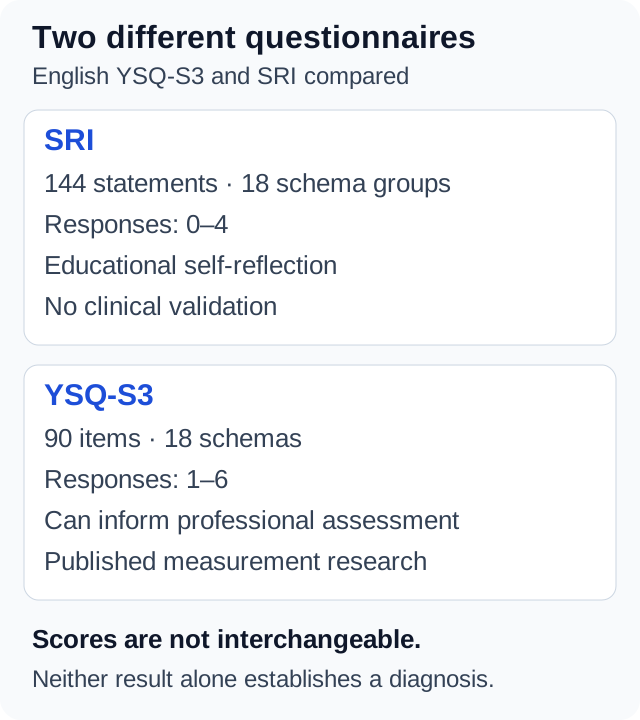
The Schema Reflect Inventory (SRI) and the Young Schema Questionnaire (YSQ) are different instruments. SRI is our educational self-reflection questionnaire with 144 statements. It has not been clinically validated. The YSQ-S3 is a 90-item self-report measure with published research on its measurement properties. A professional may use it alongside interviews and clinical judgment; neither questionnaire alone establishes a diagnosis.
This comparison concerns the English-language Young Schema Questionnaire, Short Form, Third Edition (YSQ-S3). Other YSQ editions, revisions and translations have their own wording, evidence and access arrangements. This article does not reproduce YSQ items or its scoring key.
If you want an optional reflection exercise, SRI can help organize themes to explore. If you need professional assessment, ask a qualified mental health professional which instrument, if any, fits your circumstances. The useful choice depends on your purpose, rather than which questionnaire has more questions or the more impressive-looking report.
SRI and YSQ-S3 at a Glance
Both instruments summarize answers across schema themes, but their scores have different meanings. This table separates the features of our site from the English YSQ-S3 described in the published older-adult study and the Schema Therapy Institute’s materials. The SRI methodology guide explains our implementation.
| Dimension | Schema Reflect Inventory | English YSQ-S3 |
|---|---|---|
| Purpose | Educational self-reflection and examples for discussion. | Self-report measurement of schemas that can inform professional assessment. |
| Items | 144 statements, eight in each of 18 schema groups; site-defined wording and grouping. | 90 items covering 18 schemas in this specific short form. |
| Scoring | Responses scored 0–4; site-defined percentages and display bands. | Responses rated 1–6; a separate scoring key and interpretation. |
| Evidence | Not clinically validated; no clinical or population norms. | Published measurement research, specific to versions, languages and samples. |
| Access | Free questionnaire, results and optional PDF; no signup. | The Institute supplies its English materials under a paid license; a professional’s fees are separate. |
| Privacy | Answers, edited wording and results stay in the browser. | Depends on the administering professional, platform and delivery method. |
The difference between 144 and 90 items describes length. It does not show that SRI measures schemas more accurately or that the instruments are interchangeable. Different item wording and response scales prevent a direct comparison of their percentages or totals.
What the Scores Can and Cannot Tell You
An SRI result describes your agreement with statements on this site. A percentage is not the probability of a diagnosis, a population ranking, or a measure of your worth. Our labels such as “Moderate” are display bands, not clinical cutoffs. A high score is a reason to examine concrete situations, not proof that one schema explains your difficulties.
A fictional SRI score example
Suppose all eight answers for one schema are 0, 1, 2, 3, 4, 2, 2 and 2. Their sum is 16. Each answer can contribute up to four points, so the maximum is 8 × 4 = 32. SRI displays 16 ÷ 32 × 100 = 50%, which falls in its “Moderate” display band. The example contains invented responses and no personal data.
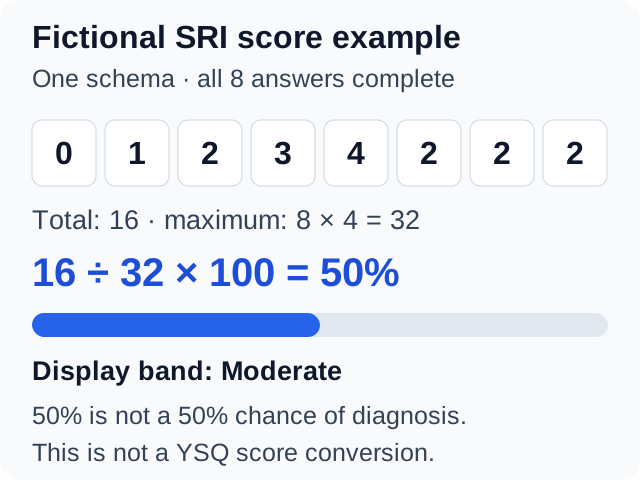
Now suppose only four statements have been answered and their points total eight. SRI still divides by 32, so the partial profile displays 25%. That lower number may reflect missing answers. An unanswered statement is not equivalent to choosing zero, and partly completed schema groups should not be compared as if they were complete.
You cannot convert that SRI percentage into a YSQ-S3 result by rescaling it from 0–4 to 1–6. The instruments ask different questions and use different scoring rules; shared schema names do not establish equivalent measurement. For SRI’s complete calculation, display bands and handling of edited wording, use the scoring and results guide.
If you repeat a questionnaire, check the version, wording, completion and current circumstances. Changing an SRI statement leaves its scoring group unchanged but can change what your answer means. A difference between two scores is not, by itself, evidence that treatment worked or a pattern disappeared.
What the Research Supports
Evidence should identify the instrument version, language, population and property studied. Reliability, for example, concerns consistency; it is not the same as diagnostic accuracy or evidence that completing a questionnaire improves health. Research on YSQ does not validate SRI.
- Phillips and colleagues’ older-adult study, first published online in 2017 and in a 2019 journal issue, included 104 adults aged 60–84; 83 repeated the questionnaire. Internal consistency was satisfactory for 13 of 18 schemas and test–retest reliability for 17 of 18. The authors identified items needing further work for this population.
- Van der Linde and colleagues’ student study, published online in 2025 and assigned to a 2026 journal issue, analyzed 401 psychology students, including 178 native English speakers. It reported internal consistency for five selected YSQ-S3 subscales in that English sample. It was not a validation of all 18 subscales in the general population.
These studies answer different measurement questions in particular samples. Their findings should not be generalized to every age, language or clinical setting. If a clinician uses another edition or translation, ask what evidence supports that exact instrument and how it contributes to their wider assessment.
Access, Cost and Privacy in Practice
The free SRI questionnaire offers all 144 statements, an 18-schema profile and optional PDF export without an account or payment. Allow about 20–30 minutes; this is our practical estimate, not an independently benchmarked completion time. It is intended for adults aged 18 or older and requires a separate local-processing choice before opening questions or saved results.
The Schema Therapy Institute’s ordering information describes its package as English-only and explains that package options contain the same materials with different device and printing arrangements. Its sample Adobe eBook agreements specify a one-year license. Check the current product terms; this describes that supplier’s materials, not every YSQ service or translation. A materials license and a professional’s assessment fees are different costs.
SRI answers, edited statements, progress and calculated results remain in your browser and are not sent to our servers for scoring or account storage. Website delivery and security processing, optional analytics and correspondence are separate. Our privacy policy and consumer health privacy notice explain those boundaries.
Local storage still needs care. Someone sharing the same browser profile may be able to open saved responses. Clearing site data can remove them. Downloaded PDFs and device backups are separate copies, so deleting browser data does not remove every exported or backed-up copy. Local processing does not make a shared device private.
For a YSQ-S3 assessment, ask the professional or service where answers are stored, who receives the report, whether it is reviewed with you and how deletion works. Paper forms, a practice portal and an online scoring platform can have different arrangements; the questionnaire’s name does not determine its privacy policy.
Choose According to Your Purpose
- For optional self-reflection: use SRI to identify possible themes and record everyday examples. You do not need a high score to justify asking for support, and a low score does not rule out a difficulty.
- For professional assessment: ask a qualified professional which questionnaire, if any, they recommend and why. Bring your questions and relevant circumstances. A questionnaire is one source of information, not a treatment plan.
- For learning the terminology: read the 18 schemas and five domains or introduction to schema therapy first. Understanding a label is different from establishing that it fits your experience.
A useful note alongside a score names the event, your interpretation, feelings and response. For example, a friend cancels a plan; you assume they do not want to see you and avoid replying. Their being exhausted is another possible explanation. This fictional example illustrates the difference between an event and an inference, without establishing which schema is involved.
Keep reflection optional and stop if it becomes distressing. Persistent difficulties affecting daily life deserve qualified support. A score cannot establish a childhood cause, assess relationship safety or determine your treatment needs. For how we select sources and describe limitations, see our editorial methodology.
Sources and Further Reading
- Phillips et al.: YSQ-S3 preliminary validation in older adults (online 2017; journal issue 2019). Evidence specific to the studied population.
- Van der Linde et al.: Exploring the links between dissociative experiences, schemas, modes, and coping (online 2025; journal issue 2026). The English subscale findings concern a student sample.
- Schema Therapy Institute: ordering information and Adobe eBook licensing agreements. Supplier-specific access terms, checked November 11, 2026.
- SRI scoring, results and limits and Schema Reflect privacy policy. Sources for this site’s implementation; not independent evidence of validation.
Continue exploring
- Schema Reflect Inventory: Scoring, Results and LimitsUnderstand SRI scores with a worked example: 144 items, 18 schemas, missing answers, edited wording, privacy, and the limits of this educational inventory.
- Which Schema Do I Have? Take the Free TestFind the right starting point: take a quick dominant-schema snapshot, complete the free 18-schema inventory, or learn the model first.
- 18 Early Maladaptive Schemas: Complete ListExplore all 18 early maladaptive schemas, their five domains, common signs, and how schema patterns shape thoughts, emotions, and relationships.
- What Is Schema Therapy? How It Works and HelpsLearn what schema therapy is, how it works, and how to use it to change repeating emotional loops. Includes practical tools, evidence-based benefits, and FAQ.
Start free schema test
Allow about 20–30 minutes. No registration required. Your answers stay in your browser.
See your 18-schema profile