What Is the Failure Schema?
This schema involves the belief that one has failed, will inevitably fail, or is fundamentally inadequate relative to peers in achievement.
This is a recurring expectation about competence in achievement areas, such as education or work. It goes beyond recognizing a particular mistake or a skill that needs practice. A setback, fear of an upcoming task, or questionnaire score alone cannot establish this pattern.
Common Signs
These are possible patterns to reflect on, not diagnostic criteria:
- Avoiding challenges or new opportunities
- Comparing yourself negatively to others
- Giving up quickly when things get difficult
- Focusing on failures while dismissing successes
- Feeling inadequate compared to peers
Fictional Everyday Examples
- Not applying for jobs because "I won't get it anyway"
- Seeing others' success as proof of your failure
- Catastrophizing minor setbacks
- Underachieving despite having the ability
Consider the circumstances as well as the interpretation. Skills, access to support, unclear expectations, fatigue, and external barriers can affect performance. They deserve attention alongside any recurring belief about your competence.
A piece of work comes back with three sentences of praise and one correction. The praise brings brief relief, but the correction soon overshadows it. The note says one calculation needs fixing. It can feel closer to "you are not good enough."
That gap between what happened and what it seemed to mean is where self-worth and perfectionism can meet. A correction is an event. A verdict on who you are is an interpretation added to it. Separating the two leaves room to address the work without treating your reaction as a diagnosis.
Failure vs. Defectiveness and Unrelenting Standards
Schema therapy uses the term schema for a recurring pattern that shapes which details someone notices and what they take those details to mean. The model offers possible explanations for recurring experiences. Recognizing a pattern doesn't establish a diagnosis. Three patterns sit close to perfectionism.
Defectiveness/Shame concerns personal acceptability. The felt sense is "something about me makes me unacceptable or unlovable." It is a belief about the person as a whole.
Failure concerns achievement and competence. The 18-schema overview describes it as the belief that you have failed, will fail, or are less capable than peers in achievement areas. A recurring expectation of failure extends beyond a particular setback.
Unrelenting Standards/Hypercriticalness concerns demanding internal rules. The International Society of Schema Therapy (ISST) describes it as the belief that one must strive to meet very high internalized standards of behavior and performance, usually to avoid criticism. A preference for doing well doesn't, by itself, establish this pattern.
| Pattern | Illustrative meaning | What it concerns |
|---|---|---|
| Defectiveness/Shame | "Something about me makes me unacceptable." | Personal acceptability |
| Failure | "I am broadly less capable in achievement." | Expected competence |
| Unrelenting Standards | "I must meet demanding internal rules." | Required conduct |
These illustrative meanings help explain the differences. They aren't test items, and recognizing a line doesn't mean the pattern applies to you.
Worth and competence need separating too. "I need practice with this skill" may be accurate. "I am incapable" stretches one task over every task. "I am unacceptable" turns a performance judgment into a judgment about the person. One setback cannot establish either broad conclusion. The defectiveness schema describes a recurring expectation of being unacceptable or unlovable. Schema Reflect's guide offers an educational reflection aid and states that it isn't a validated worksheet or treatment exercise.
Ambition can leave room for rest, satisfaction, and relationships. The University of Maryland Counseling Center's resource on perfectionism and low self-esteem recommends standards that can be high but remain achievable. Gaudreau and Benoît's 2025 study of graduate students also found evidence that pursuing excellence and pursuing perfection are conceptually distinct. That finding doesn't place every ambitious person into a fixed category.
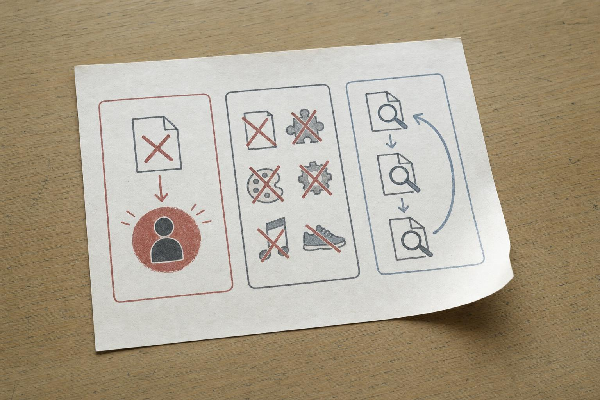
How Perfectionism Can Keep Self-Worth Conditional
One possible link between these patterns is a repeating sequence. Perfectionism does not always conceal shame, and the patterns can occur together, separately, or not at all.
- Feedback or a comparison arrives.
- A broad judgment about worth attaches to it.
- A rigid performance rule forms to prevent that judgment from recurring.
- The rule drives checking, withdrawal, or overwork.
- The result brings temporary relief or disappointment.
- Either way, the pressure renews.
The Centre for Clinical Interventions (CCI) describes how meeting a standard can lead someone to decide it was too low and set a higher one. Achievement then offers little lasting sense of completion. Its handout on perfectionistic thinking also explains that expectations influence attention and interpretation. Someone expecting inadequacy may dismiss evidence of competence as luck while treating an error as proof. Judging self-worth almost entirely by whether demanding standards were met can keep this sequence going.
For example, a colleague presents a plan, one slide gets questioned, and that slide becomes their whole memory of the meeting. The question may identify a real weakness in the plan. Remembering only that moment leaves out the rest of the evidence.
People may respond to these judgments in different ways:
Surrender
In ISST's description of coping styles, surrender means accommodating to a pattern and acting as though it is how things should be. Here it might sound like accepting a broad verdict: "I am not capable, and this correction confirms it."
Avoidance
Evaluation gets sidestepped. Drafts stay private, projects stall, and requests for feedback go unsent.
Overcompensation
Someone tries to disprove the verdict through faultlessness, checking every detail repeatedly in an effort to prevent criticism.
None of these responses identifies a schema on its own. Procrastination, for example, can come from fatigue, unclear instructions, competing demands, or inaccessible conditions. Perfectionistic effort likewise doesn't prove that a particular belief lies underneath it.
A 2024 meta-analysis of adults associated greater perfectionistic concerns with lower self-esteem. It did not establish which causes which or explain any individual's reaction to feedback.
A Worked Reflection: Feedback Without a Verdict on Worth
This original educational illustration uses a fictional person. It isn't a patient account, a diagnostic checklist, a validated worksheet, or a treatment protocol.
Riley submits a course project. The feedback says the explanation is clear and one calculation needs correction. Three thoughts follow. The first concerns achievement: "I am not capable of this kind of work." The second concerns acceptability: "The instructor now sees what I really am." The third sets a rule: "I should never hand in anything that needs revision." The feedback identifies a calculation error; it doesn't establish any of those wider claims. A reflection can separate what happened from what Riley added, then identify what the task needs.
| Observable event | Added judgment | Context and missing evidence | Practical need | Proportionate next step |
|---|---|---|---|---|
| Feedback: explanation clear, one calculation needs correction. | "I am not capable of this work." | Earlier assignments passed; this method is new and practice has been limited. | Targeted practice on the method. | Work through similar problems before resubmitting. |
| Same feedback. | "The instructor now sees what I really am." | The note praised the explanation; nothing in it addresses Riley as a person. | A reading of the note as written. | Re-read the feedback and list what it says, line by line. |
| Same feedback. | "I should never need revision." | Revision is built into the course; the instructions for this step were unclear to several students. | Clarification of what the step required. | Ask which part of the calculation was off and why. |
The criticism may be correct. Riley may have practiced too little, the instructions may have been unclear, or both. The table doesn't assume the feedback is wrong or declare the work adequate. Requesting clarification and arranging targeted practice address the error without extending it into a judgment about Riley's worth.
Two prompts to answer privately:
- What did the feedback say, word for word, and what did I add?
- If a friend showed me this exact note, what would I think it said about them?

Practice Flexible Standards Without Abandoning Care
Flexible standards fit the task and leave room for other needs. The following is an educational reflection exercise, not a treatment program.
Choose a low-stakes task. Start where an imperfection costs little: a routine personal email, a shopping list, or a note to a friend. Exclude safety-critical work, anything involving consent, and anything where accuracy protects someone else. Nothing here recommends deliberate mistakes or reduced safeguards.
Define the actual requirement. A routine email needs the right recipient, a clear point, and accurate information. It doesn't need a fourth re-read for rhythm. Ask what further checking would change. If you can't name anything, consider whether the checking is serving a rigid rule rather than the task.
Decide when to stop. Write an optional stopping rule before starting. For that email: one draft, one read for accuracy and tone, then send. Notice whether the urge to keep checking concerns a specific problem or the possibility of criticism.
The unrelenting standards schema can help describe demanding internal rules that leave little room for rest or a sense of completion. Schema Reflect presents its questionnaires and reflections as educational conversation starters, not diagnosis or treatment.
Keep room for needs beyond achievement. Sometimes a task calls for training, clarification, accessibility support, rest, or a boundary with someone who keeps moving the target. A broad judgment about your worth can obscure those practical needs. Judging yourself almost entirely through achievement also gives other parts of life little weight. Relationships, leisure, and personal qualities needn't become replacement tests for earning worth.
An optional next step is to try a stopping rule on one low-stakes task and make a short note afterward about what happened and how you interpreted it. For more structured learning, CCI's perfectionism self-help resource offers educational modules, worksheets, and suggested activities. Those materials do not establish outcomes for this article's original reflection exercise.
Pause the reflection if it increases distress. If shame or distress persists or interferes with daily functioning, consider discussing these notes with a qualified mental-health professional. Schema Reflect's educational summaries can also help name concerns you want to bring to that conversation.
For more examples of the three responses, read schemas versus coping styles. If you use the Schema Reflect Inventory, treat its scores as prompts for reflection. This original educational questionnaire has not been clinically validated and does not diagnose a condition.
FAQ
Is the failure schema the same as fear of failure?
No. Fear of failing at a particular task can reflect its difficulty, uncertainty, or real consequences. The Failure schema describes a broader recurring expectation of inadequacy in achievement areas. Context and patterns across time matter more than one anxious moment.
Can a successful person recognize a failure pattern?
Achievements do not automatically determine how someone interprets their competence. A person might dismiss successes while treating a correction as proof of a broader inadequacy. That interpretation is something to explore alongside the full evidence; achievement or self-doubt alone does not establish a schema.
How is the failure schema different from perfectionism?
Failure concerns expected competence; Unrelenting Standards concerns demanding internal rules. Perfectionistic checking might be an attempt to prevent criticism or disprove a fear of inadequacy, but it does not establish which schema is involved. The patterns can overlap or occur separately.
Does procrastination always indicate a failure schema?
No. Fatigue, unclear requirements, competing demands, missing resources, and concerns about evaluation can all affect starting a task. The University of Maryland Counseling Center’s procrastination resource describes several possible explanations. Look at the practical circumstances as well as the meaning you give the task.
Sources and Further Reading
- International Society of Schema Therapy: central concepts and definitions of Failure, Defectiveness, and Unrelenting Standards
- International Society of Schema Therapy: coping styles
- Centre for Clinical Interventions: What Maintains Perfectionism (information sheet; PDF)
- Centre for Clinical Interventions: Challenging Perfectionistic Thinking (information sheet; PDF)
- Centre for Clinical Interventions: perfectionism self-help modules
- University of Maryland Counseling Center: Perfectionism and Low Self-Esteem
- University of Maryland Counseling Center: Time Management and Procrastination
- Gaudreau and Benoît (2025): Distinguishing perfectionism and excellencism in graduate students
- Khossousi and colleagues (2024): The relationship between perfectionism and self-esteem in adults: a systematic review and meta-analysis
- Schema Reflect: Defectiveness and Shame Schema
- Schema Reflect: 18 Early Maladaptive Schemas
- About Schema Reflect